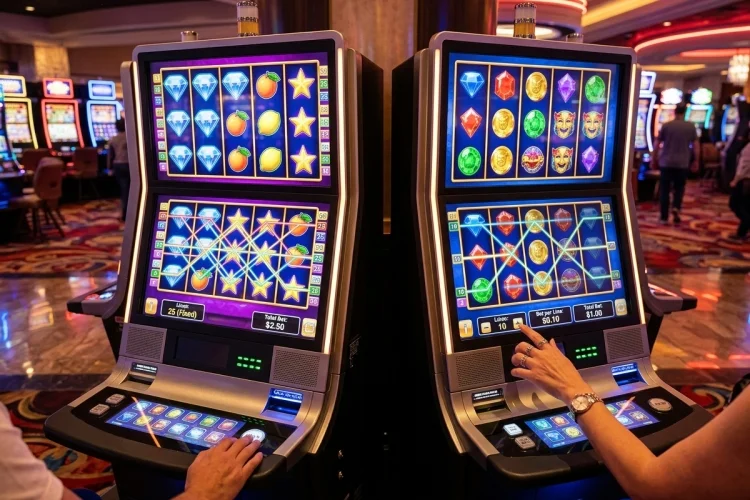
A slot can land ten losing spins in a row, show the same symbol repeatedly, or produce two bonus rounds surprisingly close together. When that happens, it is tempting to believe the game is building toward something.
That intuition is exactly why understanding Why Slot Results Cannot Be Predicted from Previous Spins matters. Modern regulated online slots use random outcome systems designed to make future results unpredictable.
A previous win, loss, near-miss, or long streak may look meaningful, but it normally provides no useful information about what the next independent spin will produce.
Every Spin Starts as a New Random Event
The easiest way to understand slot randomness is to compare it with repeated coin flips.
Imagine flipping a fair coin five times and getting heads every time. The sixth flip does not suddenly become more likely to produce tails simply because tails has been absent. Each new flip starts with the same underlying probabilities.
A standard RNG-based slot works on a similar principle. When a new independent game round is initiated, the random number generator determines an outcome according to the game’s programmed mathematical model.
The previous spin has already finished. It does not leave behind a “debt” that the next round has to repay.
This concept is known as independence of events, and it explains why looking at a history of slot results cannot reveal the next one.
How a Random Number Generator Works
RNG stands for Random Number Generator. It is the system used by many digital casino games to produce values that are translated into game outcomes.
The exact technical implementation differs between gaming platforms, but the important principle is unpredictability. UK Gambling Commission technical standards require random outcomes to be acceptably random and unpredictable.
The regulator also prohibits adaptive behaviour that changes game probabilities based on previous prizes or losses in ways that undermine the advertised probabilities.
So if somebody loses several spins, the software should not decide, “This player has lost enough, so make the next one a winner.”
The reverse is also true. A large win does not automatically force the next spin to lose.
That is what makes attempts to read previous spins as a forecasting tool fundementally unreliable.
A Simple Example: Ten Losing Spins
Suppose a fictional slot has a particular prize event with a 1-in-100 chance on each independent spin.
You play ten rounds and never trigger it.
What is its probability on spin eleven?
Assuming the event remains independent and the game’s conditions have not changed, it is still 1 in 100. The previous ten misses do not turn the next probability into 1 in 90.
Now imagine 99 spins have passed without the event.
It may feel as though the 100th spin “must” produce the prize. But a 1-in-100 probability does not mean the event appears exactly once in every block of 100 rounds.
It describes probability across a very large number of trials.
You could hypothetically see the event twice within ten spins or fail to see it for hundreds. Both are possible within random variation.
Why Winning and Losing Streaks Still Happen
If outcomes are random, why do slots sometimes produce obvious-looking streaks?
Because randomness naturally creates clusters.
Flip a coin hundreds of times and you should expect to see sequences containing several consecutive heads or tails. Random sequences rarely alternate perfectly.
Slots behave in a comparable way. A player may encounter several wins close together, followed by a long stretch of losses. Another session may show the opposite pattern.
Our brains are extremely good at noticing patterns, even when those patterns have no predictive meaning.
After three wins, someone might think a slot is “hot.” After 20 losing spins, another player might decide it is “due.”
Neither conclusion tells us what the RNG will produce next.
A streak describes what already happened, not what must happen afterward.
The Gambler’s Fallacy Makes Patterns Feel Predictable
The belief that one outcome becomes more likely simply because the opposite outcome has happened repeatedly is commonly known as the gambler’s fallacy.
A classic example appears in roulette. If red has landed eight times in a row, people may begin betting heavily on black because it seems overdue.
Slots create similar thinking.
A player might believe:
“Nothing has paid for 30 spins, so the bonus must be getting close.”
That conclusion confuses probability with balance. Random systems do not need to make short sequences look fair.
A long losing run does not create a requirement for the game to compensate the player. Likewise, several prizes in quick succession do not prove the machine has entered a special winning cycle.
This is one reason chasing losses based on perceived patterns can become particulary risky.
RTP Does Not Tell You When a Win Is Coming
Return to Player, or RTP, is another statistic that can create confusion.
Suppose a slot has a theoretical RTP of 96%. Some players interpret this as meaning every $100 wagered should eventually return $96 to them personally.
That is not what RTP means.
The UK Gambling Commission explains that RTP represents theoretical performance over a significant amount of play. Individual sessions can finish far above or below the published figure.
Imagine one player wagers $100 and receives $30 in prizes. Another wagers the same amount and hits a $500 prize.
Those short sessions look completely different, yet neither result proves the stated RTP is incorrect.
RTP is a long-term mathematical property. It does not provide a countdown to the next win and cannot be used to predict an individual spin.
Near-Misses Do Not Mean a Jackpot Is Getting Closer
Near-misses are another common source of mistaken predictions.
Imagine a slot shows two jackpot symbols while the third required symbol lands one position away. Visually, that can feel dramatically closer than a spin showing completely unrelated symbols.
From a prediction standpoint, however, the important question is how the game’s RNG and paytable determine outcomes.
A near-miss does not normally mean the jackpot has progressed toward completion. The next independent spin begins with its own random outcome.
Seeing two bonus symbols ten times without triggering the feature also does not prove the feature is becoming more likely.
The screen shows the result of that particular round, not a progress bar for future randomness unless the game explicitly includes a persistent feature described in its rules.
What About Slots With Persistent Features?
There is one useful nuance.
Some modern slots contain visible meters, collected symbols, persistent features, or other game states that carry information from one round into another. In those games, the rules themselves may change what is available on a later spin.
That is different from predicting randomness from a pattern of previous wins and losses.
If a game explicitly says collecting ten symbols unlocks a feature and you already have nine, that visible state obviously matters. You are using published game mechanics, not trying to decode the RNG.
Players should therefore read the paytable and feature rules carefully.
Previous random results alone do not provide a reliable prediction signal. Explicit persistent game mechanics are a seperate issue.
Why Betting Systems Cannot Solve the Problem
Once players believe streaks contain information, betting systems often follow.
Someone might double the stake after each loss or increase bets because a bonus appears “close.” The problem is that changing the stake does not make an independent random outcome easier to predict.
If the probabilities remain unchanged, doubling your bet after five losing spins simply means risking more money on the sixth.
Bet progression can dramatically change the size of wins and losses, but it does not transform historical spin data into useful predictive information.
A better approach is to choose a fixed entertainment budget, understand the game’s RTP and volatility, and avoid increasing stakes because of an imagined pattern.
Understanding Why Slot Results Cannot Be Predicted from Previous Spins comes down to one idea: independent random outcomes do not remember earlier rounds.
Losing streaks, winning streaks, and near-misses may look meaningful, but they do not reveal what comes next.
Read the game’s rules, understand its RNG, RTP, and volatility, and treat every new independent spin as uncertain rather than trying to chase patterns.