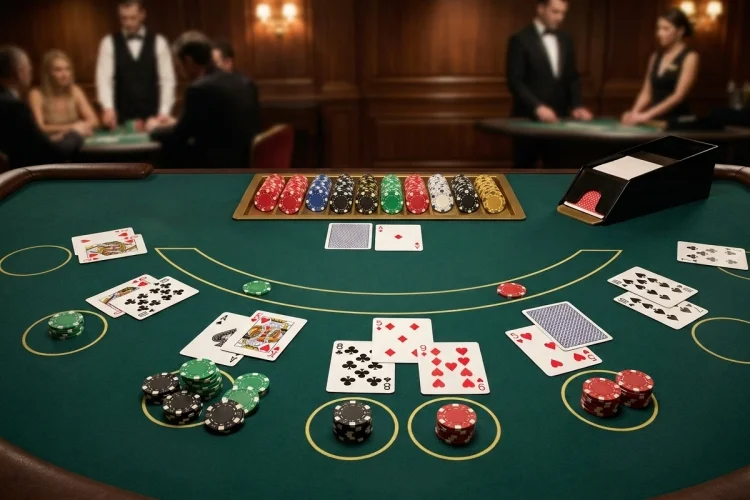
Blackjack often gets described as one of the casino games with a relatively low house advantage, but that statement needs some context. The percentage is not fixed across every table, and the way you play can influence the expected return.
So, What Is the House Edge in Blackjack? In simple terms, it is the mathematical advantage the casino expects to have over the long run under a particular set of rules and playing strategy.
Understanding that number helps you compare tables realistically without assuming it predicts what will happen during your next few hands.
What Does House Edge Actually Mean?
The basic definiton is simple: house edge measures the casino’s expected advantage relative to the player’s initial wager.
The UK Gambling Commission describes house edge as the percentage a casino would expect to retain on average from each hand or spin under normal patterns of play.
Suppose a blackjack game has a hypothetical house edge of 0.5%.
If you place $1,000 in total initial bets over a long period, the theoretical expected loss would be about $5.
That does not mean you will lose exactly $5.
You might finish $200 ahead, lose $150, or experience something completely different during a short session. House edge describes a long-term mathematical expectation, not a guaranteed bill charged after every hundred hands.
Why Blackjack Has No Single House Edge
Unlike a simple fixed bet, blackjack involves decisions.
You can hit, stand, split, double, and sometimes surrender. The dealer also follows rules that vary between tables.
That means the house edge depends on both the table rules and the decisions made by the player.
Wizard of Odds offers a blackjack calculator covering thousands of possible rule combinations, including deck count, soft-17 rules, doubling restrictions, surrender, splitting, and blackjack payouts.
This is why saying “blackjack has a 0.5% house edge” without mentioning the rules is incomplete.
One table might fall around that area with strong rules and correct basic strategy, while another version can be noticeably worse.
Basic Strategy Helps Reduce the Casino Advantage
Blackjack is unusual because player decisions influence expected return.
Basic strategy is a mathematically calculated approach showing the best standard action for each player hand against each dealer up-card under a given ruleset.
It does not predict which card comes next.
Instead, it chooses the decision that produces the best long-term expected result based on probability.
For example, standing on 16 against a dealer 10 may feel safer because drawing another card could bust the hand. However, the mathematically preferred action can differ depending on the exact rules and whether surrender is available.
Wizard of Odds maintains separate strategy charts for single-deck, multi-deck, and European games because the correct strateggy changes when rules change.
Following basic strategy cannot guarantee profit. It simply avoids giving the casino additional advantage through unnecessary decision errors.
A Simple $10 Bet Example
Imagine a blackjack table with a hypothetical house edge of 0.6% when basic strategy is followed.
You bet $10 per hand for 100 hands.
Your total initial wagering volume is $1,000, so the theoretical expected loss would be:
$1,000 × 0.006 = $6.
That number is an average expectation across an enormous amount of comparable play.
During your actual 100 hands, results will almost certainly bounce around. Blackjacks, doubles, splits, streaks, and ordinary card variation can produce much larger short-term gains or losses.
This is one of the most important things to understand about casino mathematics.
A low house edge means the expected long-term cost relative to betting volume is smaller. It does not make short sessions predictable.
Why the Blackjack Payout Matters So Much
One of the first rules to check is how a natural blackjack pays.
Traditional blackjack commonly pays 3:2. A $10 natural blackjack therefore earns $15 in profit.
Some tables pay only 6:5, reducing that profit to $12.
That three-dollar difference looks modest on one hand, but natural blackjacks occur often enough for the reduced payout to have a significant effect over time.
Wizard of Odds estimates that changing blackjack payout from 3:2 to 6:5 increases the house advantage by about 1.39 percentage points under its standard comparison assumptions.
That is much larger than many other common rule changes.
A table offering 3:2 blackjack is therefore usually worth identifying before worrying about tiny differences elsewhere.
Soft 17 Changes the Mathematics Too
A soft 17 contains an Ace counted as 11, such as Ace-6.
Some tables require the dealer to stand on soft 17. These are often labelled S17.
Others require the dealer to hit, known as H17.
Hitting soft 17 benefits the casino because the dealer gets an additional opportunity to improve certain hands.
Wizard of Odds estimates that changing from S17 to H17 costs the player around 0.22 percentage points under its standard rule comparison.
Again, that does not mean every H17 table has exactly the same overall edge. Other rules still matter.
Think of each rule as one piece of a larger mathematical package.
Splitting and Doubling Rules Also Matter
Blackjack becomes more interesting because strong hands sometimes allow players to increase their wagers.
A table may allow doubling on any first two cards, while another limits doubling to totals such as 9, 10, or 11.
Some tables allow double after split, commonly abbreviated DAS.
Removing DAS increases the house advantage by roughly 0.14 percentage points under Wizard of Odds’ comparison assumptions. Restricting doubling to 9–11 instead of any first two cards costs roughly another 0.09 percentage points.
These differences sound small, but several unfavourable rules can accumulate.
That is why two blackjack tables sitting beside each other may have differnt expected returns even though the game looks almost identical.
Does Fewer Decks Always Mean a Better Game?
Using fewer decks generally benefits the player when every other rule remains equal.
Wizard of Odds’ comparison gives single-deck play roughly a 0.48-percentage-point improvement in player return relative to its eight-deck baseline.
The catch is that other rules are rarely identical.
A single-deck table might compensate by paying 6:5 instead of 3:2, restricting doubles, or changing other conditions.
That can easily erase the benefit of having fewer decks.
So do not choose a blackjack game just because “single deck” appears in the title.
Read the complete rules.
House Edge and RTP Are Two Sides of a Similar Idea
House edge describes the portion the casino expects to retain on average, while RTP describes the theoretical percentage returned to players.
In a simplified game with a 0.5% house edge, the theoretical return would be approximately 99.5%.
Blackjack needs extra care because player decisions affect the calculation.
UK remote gambling standards therefore state that games involving skill should calculate theoretical RTP using an autoplay strategy or a standard published strategy where applicable.
This prevents the advertised mathematical information from being completely disconnected from how the game is supposed to be played.
It still does not tell you what your personal session will return.
Side Bets Have Their Own House Edge
Insurance, Perfect Pairs, 21+3, and other blackjack side bets should be treated as separate games mathematically.
They may use the same cards, but their payout structures and probabilities are different from the main blackjack hand.
For example, Wizard of Odds notes that insurance carries a 5.9% house edge in a standard single-deck example.
Other side bets can have completely different figures.
This is why a blackjack table with an attractive main-game house edge does not automatically mean every button on the interface offers the same value.
Always evaluate optional wagers seperately.
So, What Is the House Edge in Blackjack? It is the casino’s long-term mathematical advantage under a particular combination of rules and player decisions.
A favourable blackjack game can have a relatively small edge, but payouts, soft 17, splitting, doubling, and strategy all influence the final number.
Before playing, check the rules and use the appropriate basic strategy rather than judging the game by its name alone.